Artist statement examples and how to write yours (by medium, with a 4-sentence formula)
A working artist statement formula, five short examples for painting, murals, photography, sculpture and digital work, the mistakes juries notice first, and how to adapt one statement to every application.
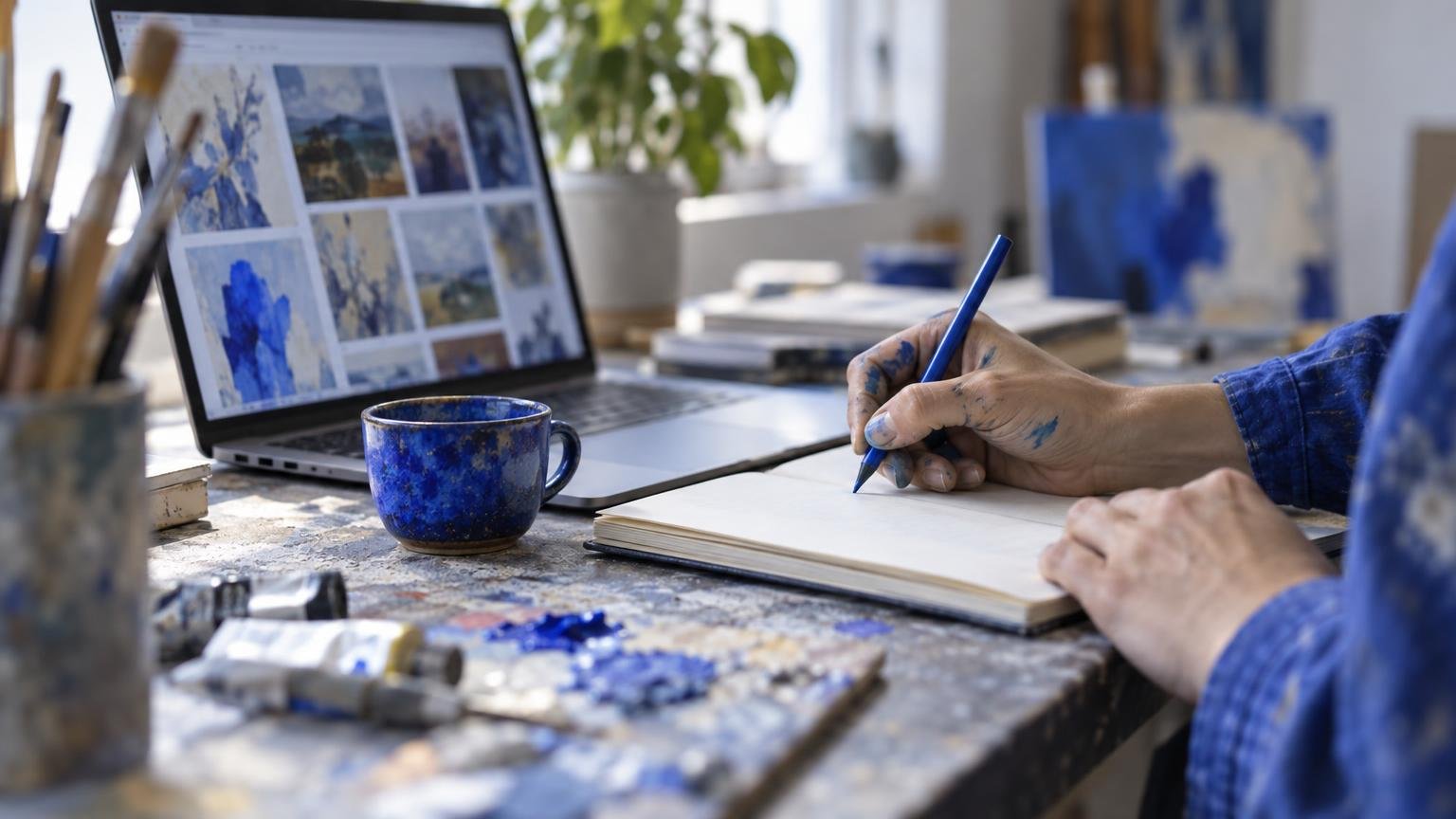
Short answer: an artist statement is 100 to 250 words, in the first person, that says what you make, how you make it, what it is about and why it matters now. Four sentences can do it. Write it in plain language a stranger could repeat back to you, keep one version at 100 words and one at 250, and rewrite the first sentence for every application so it points at that residency, grant or call. The examples below are templates to steal the structure from, not the words.
What an artist statement is for
A juror has your ten images on one screen and your statement on the other. The images show what the work looks like; the statement tells them how to look. It is not a biography, not a CV, not a manifesto. If the statement could be attached to anyone else's images, it is not finished.
Three readers use it: juries for grants, residencies and open calls; curators and galleries deciding whether to visit; and people who find your work online and want to know what they are looking at. Write for the first group and the other two are covered.
The four-sentence formula
What you make. Medium, scale, format. "I paint large-scale murals on the exterior walls of social housing."
How you make it. The process or method that is particular to you. "Each wall starts with interviews with the residents, whose words become the composition."
What it is about. The idea, in concrete terms. "The work is about who gets to be visible in a city, and at what size."
Why now, or why you. The context that makes the work urgent or the reason you are the one making it. "I grew up in these blocks, and I am painting the people who are still there."
That is a complete 100-word statement. The 250-word version adds one sentence on influences or history, one on a recent piece, and one on what you are working toward.
If your statement could sit under someone else’s images, it is not finished.
Five short examples by medium
Each is a structure with placeholder specifics. Replace every concrete detail with your own.
Painting. "I make oil paintings of empty interiors – waiting rooms, hallways, stairwells – at the scale of the rooms themselves. I work from photographs taken at the hour the space is unused, then remove every object until only light and architecture remain. The paintings are about the time we spend in places built for nobody in particular. I am currently painting the municipal buildings of the town I was born in, one room at a time."
Murals and street art. "I paint murals that scale portraits of local residents to the height of the buildings they live in. Each project begins with a month of conversations in the neighbourhood; the composition is built from what people choose to show me. The work asks who a city makes visible and who it leaves at eye level. In 2026 I completed walls in three cities and am now working on a series of facades painted entirely in daylight with a VR headset instead of a projector."
Photography. "I photograph the edges of industrial sites at night, with long exposures that turn security lighting into the only colour in the frame. I shoot on a large-format camera, which forces me to stay for hours in places designed to move people along. The series documents what the economy looks like when nobody is supposed to be watching. The current chapter follows the perimeter of a single port over a year."
Sculpture and installation. "I build temporary structures from materials a site discards – pallets, signage, offcuts – and leave them to be taken apart by the people who use the space. The work is made on location over several days and photographed before it disappears. It is about ownership of public space and what counts as finished. My next piece is planned for a transit station, with the station's own maintenance crew as collaborators."
Digital and new media. "I make drawings that exist only through a phone camera: augmented-reality lines fixed to real walls, visible to anyone who points a screen at them. The pieces are drawn on site and anchored to the architecture, so they age with the building. The work is about the layer of the city that is already digital and who gets to draw on it. I am currently mapping a series across one neighbourhood's bus shelters."
Mistakes juries notice first
Adjectives instead of nouns. "Dynamic, bold, expressive work" says nothing. "Three-metre canvases painted with a broom" says everything.
The word "explore". You are not exploring themes of identity and memory; you are making specific things. Say what.
A CV in prose. Shows and degrees belong in the CV. The format is in Artist CV: what to include and a template.
Third person. "The artist's practice interrogates…" reads as a gallery press release. Juries want to hear you.
Length. Over 300 words and the juror skims. Under 80 and it looks like you could not be bothered.
One statement for everything. The core stays; the first and last sentences change for each call.
Adapting the statement to each application
Residencies want to know what you would do there. Grants want to know what the money makes possible. Open calls want to know why your work fits the theme. Keep the middle two sentences fixed and rewrite the first and last for each. That is a fifteen-minute job once the core exists, and it is the difference between a statement that fits and one that was clearly sent to forty places.
If you have a CV and a statement in good shape, Artists Agent uses them to draft the opening paragraph of an application for each opportunity it matches you with, grounded in your actual experience, in your voice, for you to edit and send. It is built for exactly this step: the rewrite of the first sentence, forty times.
Statement, bio, and proposal: which is which
Statement: first person, about the work, 100 to 250 words.
Bio: third person, about you, 50 to 150 words, for press and websites.
Proposal: what you will make with this grant or at this residency, with a timeline and often a budget. A template is in How to write an art grant proposal.
Juries ask for all three because they are three different documents. Sending the statement three times is the most common way to lose a reader.
FAQ
How long should an artist statement be? 100 to 250 words. Keep a short and a long version and use whichever the call asks for; when it does not say, send the short one.
Should an artist statement be in first or third person? First person. A third-person text about you is a bio, which is a different document with a different job.
What should an artist statement include? What you make, how you make it, what it is about, and why now or why you. Optionally one influence, one recent work, and what you are working toward.
Do I need a different artist statement for every application? The same core, with the first and last sentences rewritten to point at the specific residency, grant or call. A fully generic statement is the easiest rejection to spot.
Can AI write my artist statement? It can draft a structure, and juries can tell when it wrote the content. Use it to tighten what you wrote, not to invent what you think. Artists Agent drafts application openings from your own CV and statement for the same reason: the facts have to be yours.
Write the statement once, point it at the right calls. Artists Agent matches residencies, grants, open calls and festivals to your profile and drafts each application's opening from your CV and statement. Free to explore, no signup. Draft your application
▋