How to get into a mural festival: what organisers select for, and how to apply
How mural and street art festivals pick their artists, what a festival actually pays for, the portfolio that gets a wall, what to put in the application, and what happens between selection and paint.
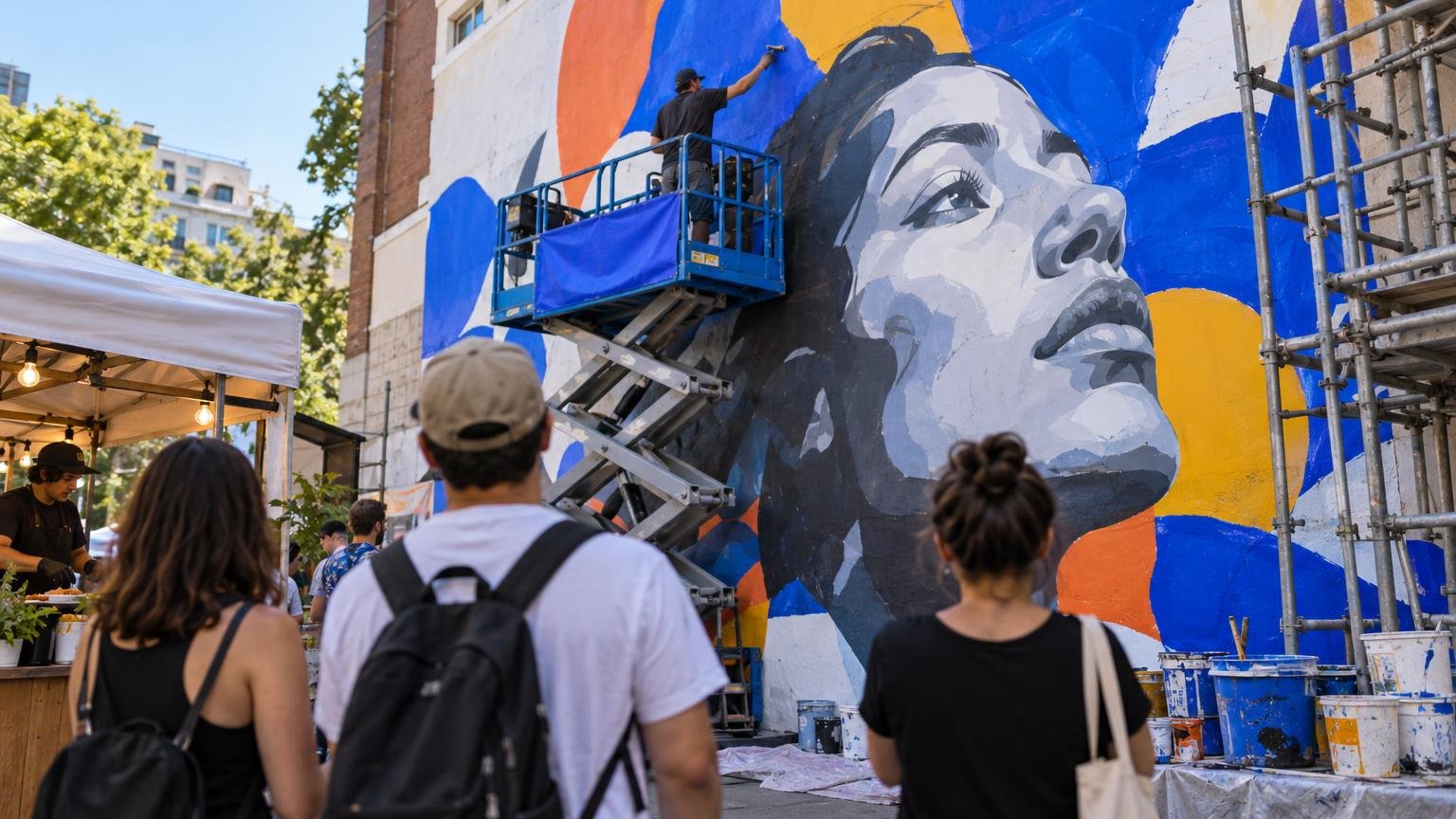
Short answer: mural festivals select artists in two ways: by invitation, for the names that sell the festival, and by open call, for most of the walls. Open-call selection is a jury looking for finished walls in your portfolio, a style the city will accept, proof you can work at scale on schedule, and an artist who is easy to host. A festival typically pays travel, accommodation, materials and a fee, and gives you a wall, a lift and an audience. Apply with ten photos of finished walls, a two-line description of what you would paint, and an honest account of your biggest wall to date.
How festivals choose
A festival has a fixed number of walls, a budget per wall, a city council to keep happy and a programme to sell to sponsors and press. The curator fills it in layers:
Headliners, invited directly, whose names bring press.
Regional artists, often required by the funding, who connect the festival to its city.
Open-call artists, chosen from applications to fill the remaining walls with range: styles, scales, countries, a balance of genders and backgrounds.
The open call is where you apply, and the jury reading it is asking four questions about you.
What the jury is looking for
Can this person paint a wall? Not a canvas, not a mock-up: a finished wall, photographed from the street, with the building around it. One real wall outweighs twenty studio pieces. If you have never painted a wall, start with a legal wall at home and photograph it well; how to plan the first one is in How to paint a mural on a wall.
Will this work fit this city? Every festival knows what its wall owners and councils will sign off. Nudity, politics and text are fine at some and impossible at others. Read last year's walls and you will know.
Can they deliver in five days? Festivals run to a schedule: wall ready Monday, finished by the weekend, documented, done. A proposal that needs three weeks is not a festival piece. Scale and speed are what a VR headset changed for a lot of muralists: the sketch goes on the wall in daylight, in minutes, and stays there the next morning. Artists who work this way often say so in the application; it is a credible answer to "can you deliver".
Are they easy to host? Clear communication, a materials list on time, a reasonable rider, a good attitude with volunteers and press. Festivals talk to each other; a difficult artist gets one festival, not ten.
A festival is not buying a finished wall by Sunday. It is buying your style.
What a festival pays for, and what it does not
The standard package is travel, accommodation, materials, access equipment and a fee. The fee ranges from a token amount at small community festivals to a proper commission at large ones. What is usually not covered: your lost income from the rest of your calendar, assistants unless agreed, and anything you decide to add to the wall after the budget is fixed.
Ask before you accept: who buys the paint, who provides the lift, is there insurance, what happens if it rains for three days. If you are pricing the festival against a commission you would otherwise take, the comparison is in How much to charge for a mural. The paint list itself is a job for the mural paint calculator.
Where festival calls are published
Most festivals announce their open call on their own site and social accounts three to six months before the event, then on aggregators. Deadlines cluster in winter for summer festivals. Following twenty festivals is manageable; following two hundred is not, which is why Sketchar built Artists Agent: festival calls sit next to grants, residencies and open calls, filtered by country, medium and deadline, and matched against your profile. Exploring is free and needs no account.
Step 1 – Build the wall portfolio
Ten images, all finished walls, each shot from the street with the whole building in frame, plus one or two process shots. Add the size, city and year to each caption. Nothing else; canvases and sketches go in a separate folder.
Step 2 – Study the festival's last two editions
Who painted, what they painted, what size the walls were, how the festival talked about them. Decide whether you fit, and which of your walls proves it.
Step 3 – Write a two-line concept, not a design
Festivals rarely want a finished sketch at application stage; the wall is not assigned yet. They want to know what you would bring: a theme, a palette, a way of working with the place. Two lines. The design comes later, for the specific wall.
Step 4 – State your biggest wall and your pace honestly
"Largest wall to date 14 × 9 m, painted in four days with one assistant." That sentence answers the jury's second and third questions at once. Inflating it costs you the festival when the wall is bigger than you can handle.
Step 5 – Send the standard documents, short
A 100-word statement that mentions walls in the first sentence, a CV with commissions and public art at the top, your Instagram or site. The formats are in Artist statement examples and Artist CV template.
Step 6 – Prepare for the gap between yes and paint
Selection usually comes two to four months before the festival. In that time you will get a wall, send a design for approval, agree a materials list, and book travel. Design at the wall's exact proportions; if the wall is curved or has corners, plan how the design wraps. The transfer method is your choice, but a festival schedule rewards whatever gets the outline up fastest in daylight, which is why many festival artists have moved from projectors to a headset; the comparison is in How to scale a mural.
Your first festival without a festival
If you have no festival on the CV, the fastest route is a smaller one: community festivals, town-council mural weeks, university programmes. They are less competitive, often free to enter, and a finished wall there is the portfolio piece that gets you the next one. How a city-wide festival looks from the inside is in Lagos painted with Sketchar.
FAQ
How do artists get selected for mural festivals? Headliners by invitation; most walls by open call, judged on a portfolio of finished walls, fit with the city, ability to deliver on schedule, and ease of hosting.
Do mural festivals pay artists? Most cover travel, accommodation, materials and equipment, and pay a fee that ranges from token to substantial. Read the call; "exposure only" festivals exist and are worth it only as a first wall.
Do I need a finished design to apply to a mural festival? Usually not. A short concept is enough at application stage; the design is made for the specific wall after selection.
What should a mural festival application include? Ten photos of finished walls with sizes, a two-line concept, your largest wall and typical pace, a short statement, a CV with commissions first, and your social links.
How do I find mural festival open calls? Festival sites and social accounts, aggregators, and Artists Agent, which lists festival calls with deadline, country and reward alongside grants and residencies.
Can I apply to a mural festival with no walls in my portfolio? You can, but you will rarely be selected. Paint a legal wall or a community wall first, photograph it from the street, and apply with that.
Festival calls, filtered to the ones you fit. Artists Agent lists mural and street-art festival open calls with deadline, country and reward, next to grants, residencies and open calls, matched to your profile. Free to explore, no signup. Find festival calls
▋