


Sketchar Editorial · History of graffiti and street art
Walls talk
Two thousand years of people writing on walls: Pompeii, revolutionary Russia, New York subway cars, galleries and murals the size of a house. Every chapter has a wall for you.
Spray on the wall
The short answer
Graffiti and street art in one breath
Three words cover most of what you see on a city wall.
Graffiti is writing or drawing on a public surface, usually without permission. The modern kind began with names written across Philadelphia and New York in the late 1960s. Street art is the wider family that grew out of it: stencils, stickers, posters and murals, made for everyone who walks past.
Tag, piece, mural
One wall can hold all three, and the chapters below go through them roughly in order: from a name scratched into plaster to a painting the size of a building. Tap the cards to flip through them.
- TagA writer's name in one colour, done in seconds. The signature everything else grew from.
- PieceShort for masterpiece: big letters, many colours, outlines and 3D. Hours of work.
- MuralA wall painted with permission, often a whole building, planned like any commission.
At a glance
- 79Pompeii is buried with thousands of messages scratched into its walls
- 1825Joseph Kyselak paints his name on rocks across the Alps
- 1918Mayakovsky and the futurists call on artists to paint the streets
- 1922Mexico starts painting murals on public buildings
- 1971The New York Times writes about TAKI 183
- 1972–73Pieces cover subway cars; graffiti gets its first gallery show
- 1980The Times Square Show; Haring draws in chalk in the subway
- 1981Blek le Rat sprays his first stencilled rats in Paris
- 1989The last painted subway car leaves service; Fairey's first sticker
- 2008Street art covers the river façade of Tate Modern
- 2017Sketchar on HoloLens: the sketch in the glasses, traced on the wall with a can
- TodayMurals the size of buildings, traced from mixed-reality headsets
79 AD · Pompeii
Before paint, there was the scratch
The word comes from Italian: graffiato means “scratched”.
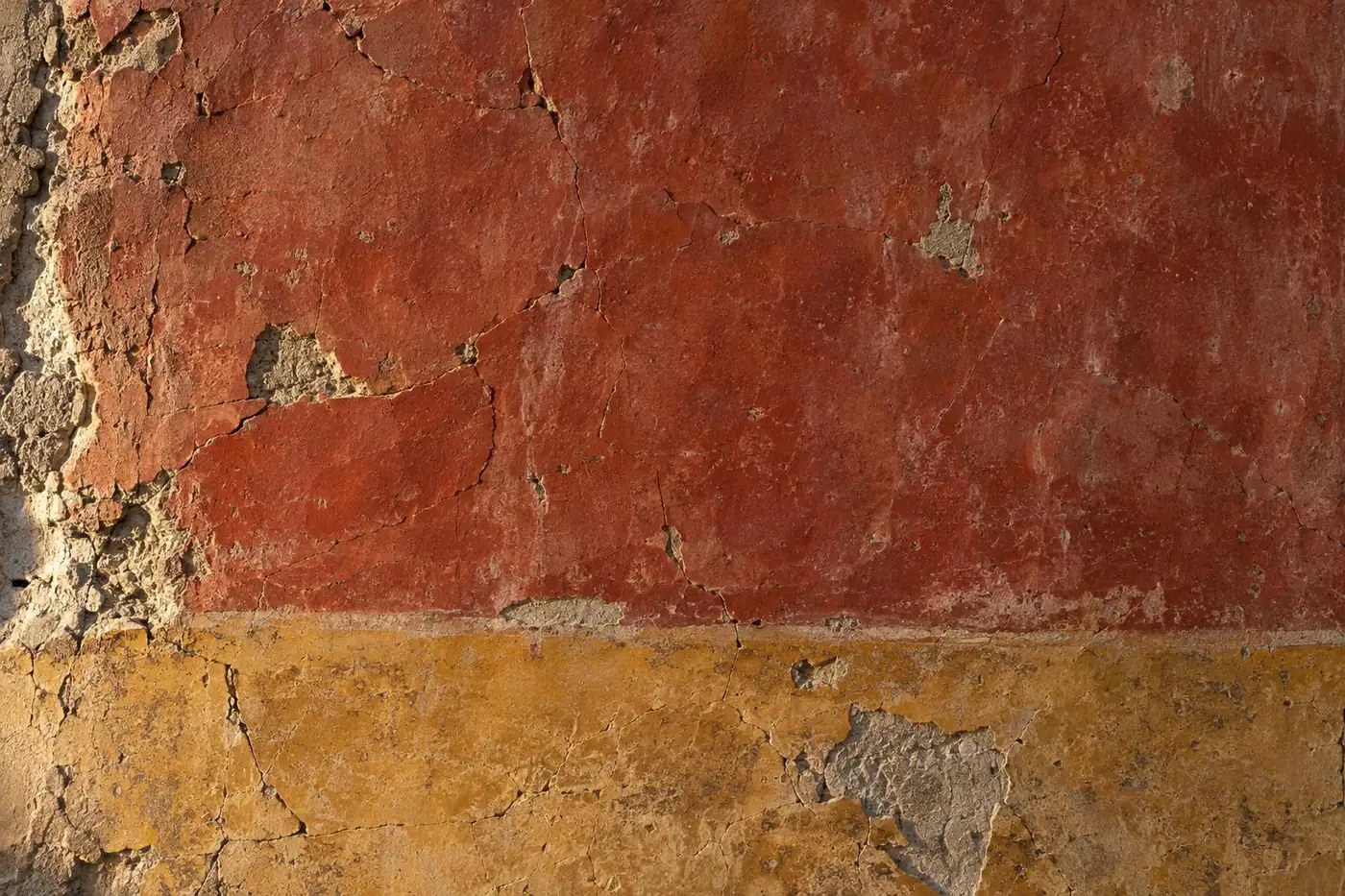
ADMIROR O PARIES TE NON CECIDISSE RVINIS QVI TOT SCRIPTORVM TAEDIA SVSTINEAS
Scratch the plaster
0 / 12
“I wonder, O wall, that you have not collapsed in ruins, since you bear the tedious scribbles of so many writers.”
Inscription CIL IV 1904, Pompeii. The wall is an illustration in Pompeian colours; the letters appear under your hand.
When Vesuvius buried Pompeii in 79 AD, it kept thousands of messages scratched and painted on its walls: names, jokes, love notes, prices, election slogans. People wrote on houses, bars and the basilica the way we write in comments today.
One line, found on several walls of the town, even takes pity on the wall itself. Scratch the plaster to read it.
1825 · Austria
Kyselak was here
A century and a half before TAKI 183, a clerk from Vienna had the same idea: one name, everywhere.
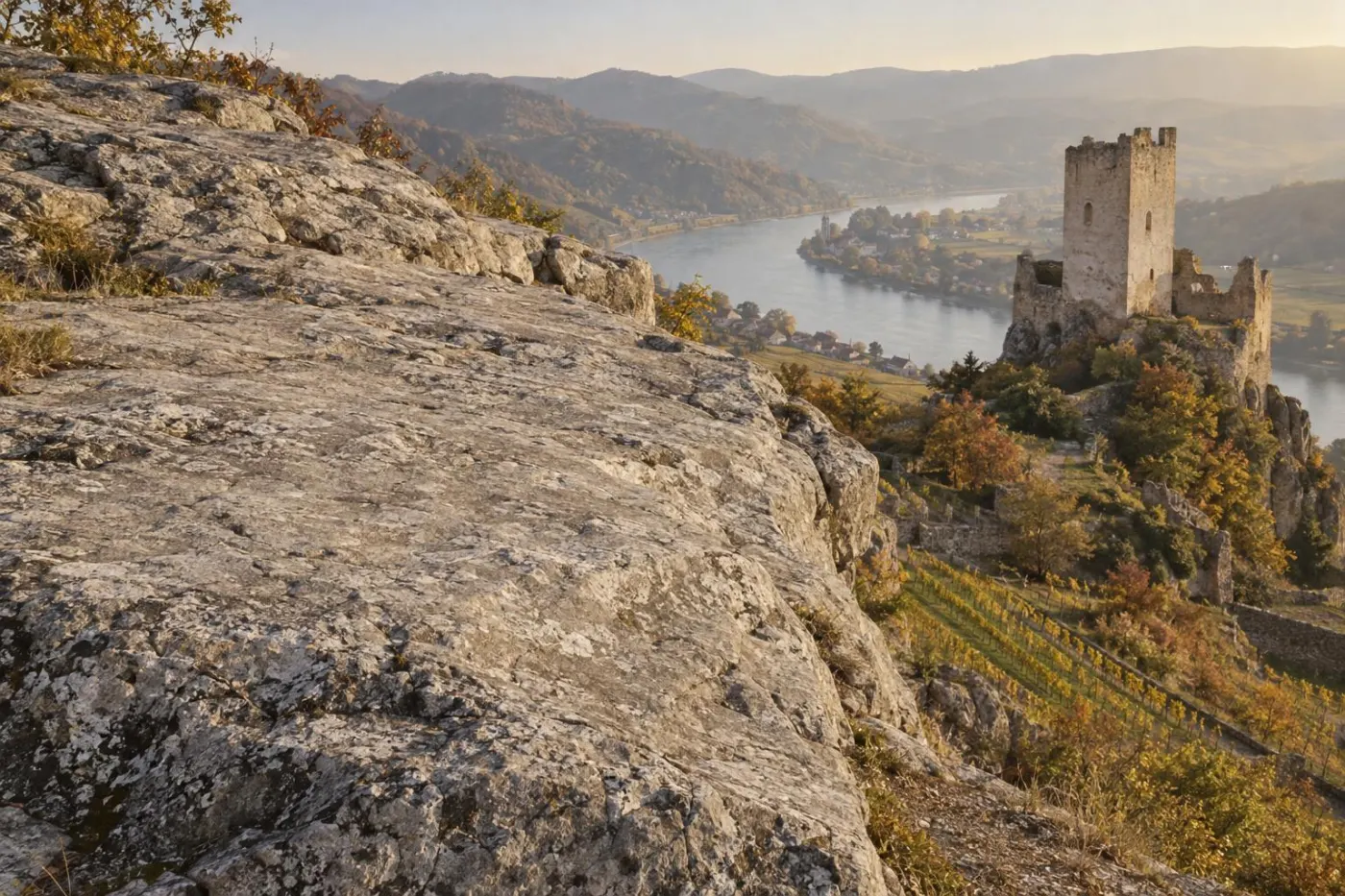
Tap to leave the name
The Wachau above the Danube, where one of his names is thought to survive. Tap a rock or the tower to paint it there yourself.
Joseph Kyselak was a junior clerk at the court treasury in Vienna. On 12 August 1825 he set out from Graz on foot and spent almost four months walking through the Alps, by way of Carinthia, Gastein, Berchtesgaden and Tyrol. On rocks, walls and ruins along the way he painted his name in big letters in black oil paint. Legend says it began as a bet that he would be known across the empire within three years.
His account of the walk came out as a book in 1829. Another legend has Emperor Francis I calling him in and telling him to stop, then finding the name on his desk after Kyselak had gone. He died of cholera in 1831, aged 33. A few signatures are thought to be his, on the defence tower in Perchtoldsdorf and a rock in the Wachau, but most “Kyselaks” are later copies: people still write his name today.
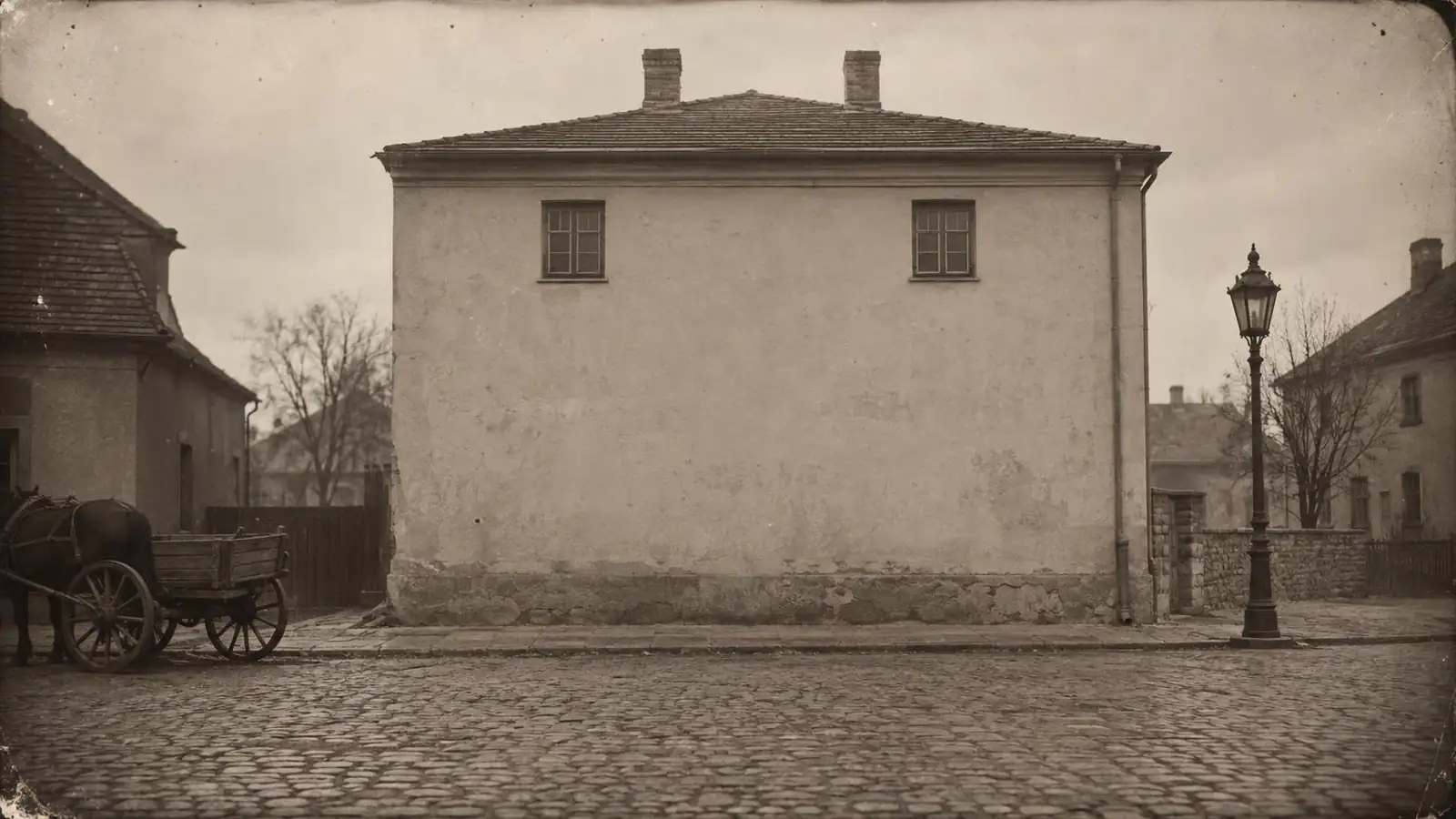
1918 · Moscow, Vitebsk
The streets are our brushes
After the revolution the futurists wanted art out of the museums and onto every wall, fence and tram.
A provincial street in 1918, as the futurists found it. The colour is yours.
On 15 March 1918 Mayakovsky, Kamensky and Burliuk published “Decree No. 1 on the Democratization of the Arts” in the Futurists' Newspaper. Artists, it said, must take their pots of paint and decorate “all the flanks, foreheads and breasts of cities, stations and the ever-running herds of railway carriages”. And: “Let the streets be a festival of art for all.”
That December Mayakovsky put it into a poem, “Order to the Army of Art”: “The streets are our brushes. The squares are our palettes.” Painted agit-trains soon carried slogans across the country. In Vitebsk, where Marc Chagall ran the art school, the town was decorated for the revolution's first anniversary, and from 1920 Kazimir Malevich's students covered its walls with squares and circles.
1922 · Mexico City
Walls for everyone
After its revolution Mexico gave its painters the walls of public buildings and its history as the subject.
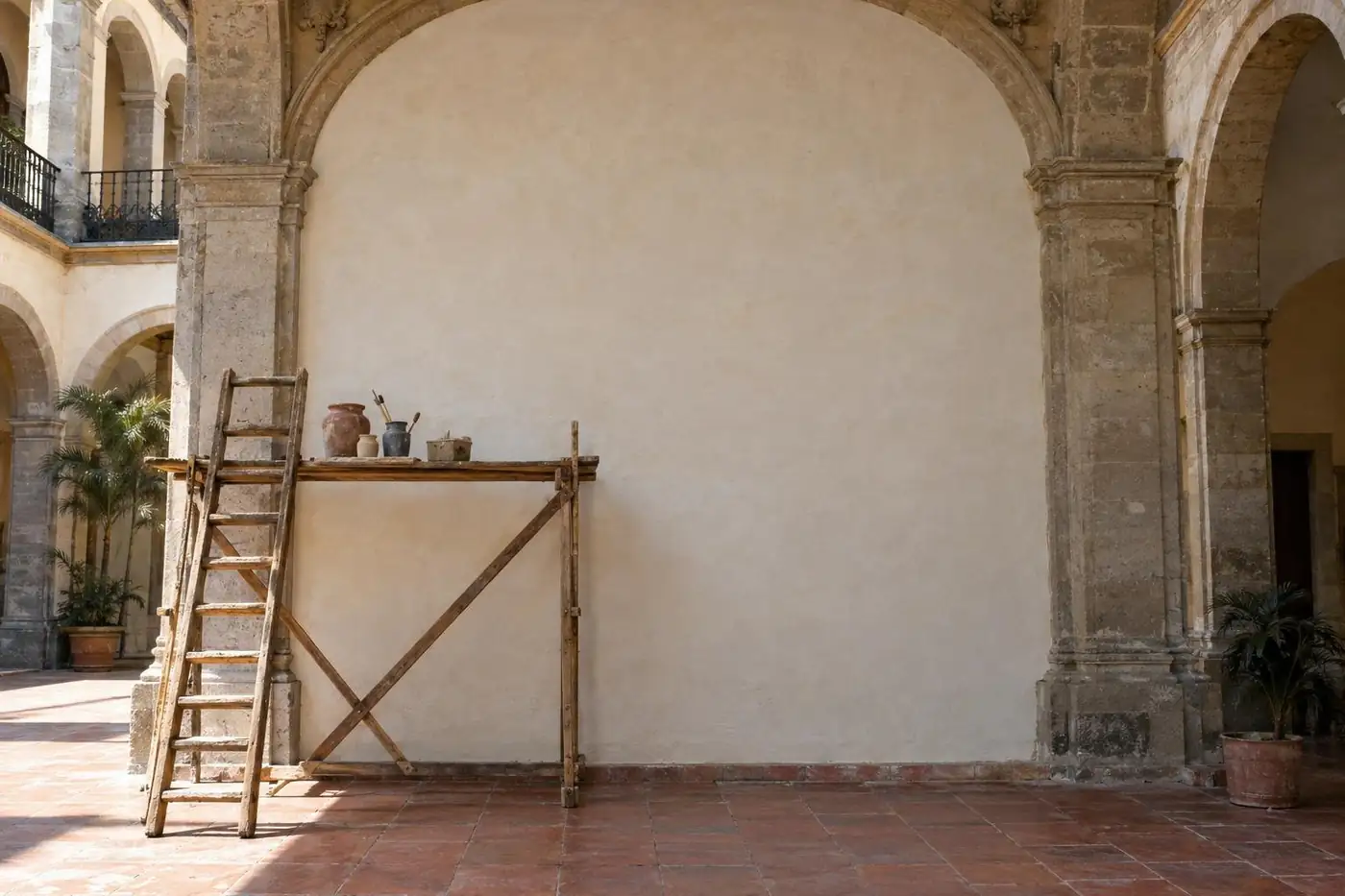
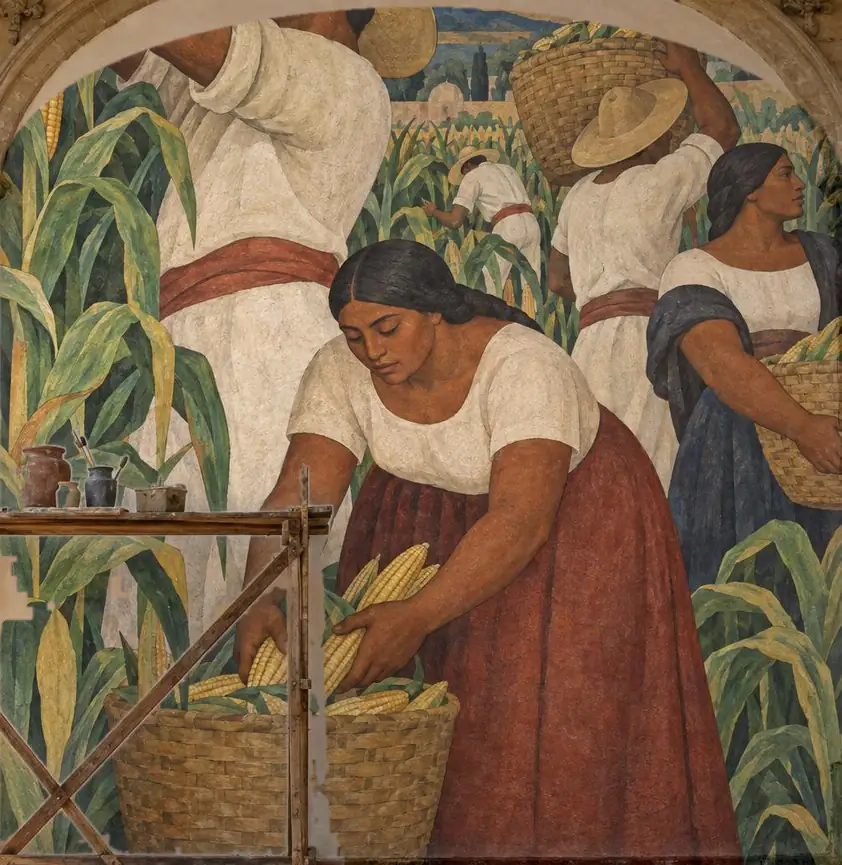
An illustration in the manner of the period. Each patch is one day's work, a giornata.
Under education minister José Vasconcelos the government commissioned murals for schools and ministries. Diego Rivera began his first at San Ildefonso in 1922, with José Clemente Orozco and David Alfaro Siqueiros at work beside him. Ten years later Rivera covered a whole court of the Detroit Institute of Arts with 27 fresco panels.
True fresco is painted into wet plaster, one patch a day, so a wall grows like a puzzle from the top down. Siqueiros went the other way: car paint, spray guns and, in 1936, a workshop in New York where a young Jackson Pollock learned to let paint fly.
1967–1971 · Philadelphia, New York
A name and a street
Modern graffiti began with a signature.
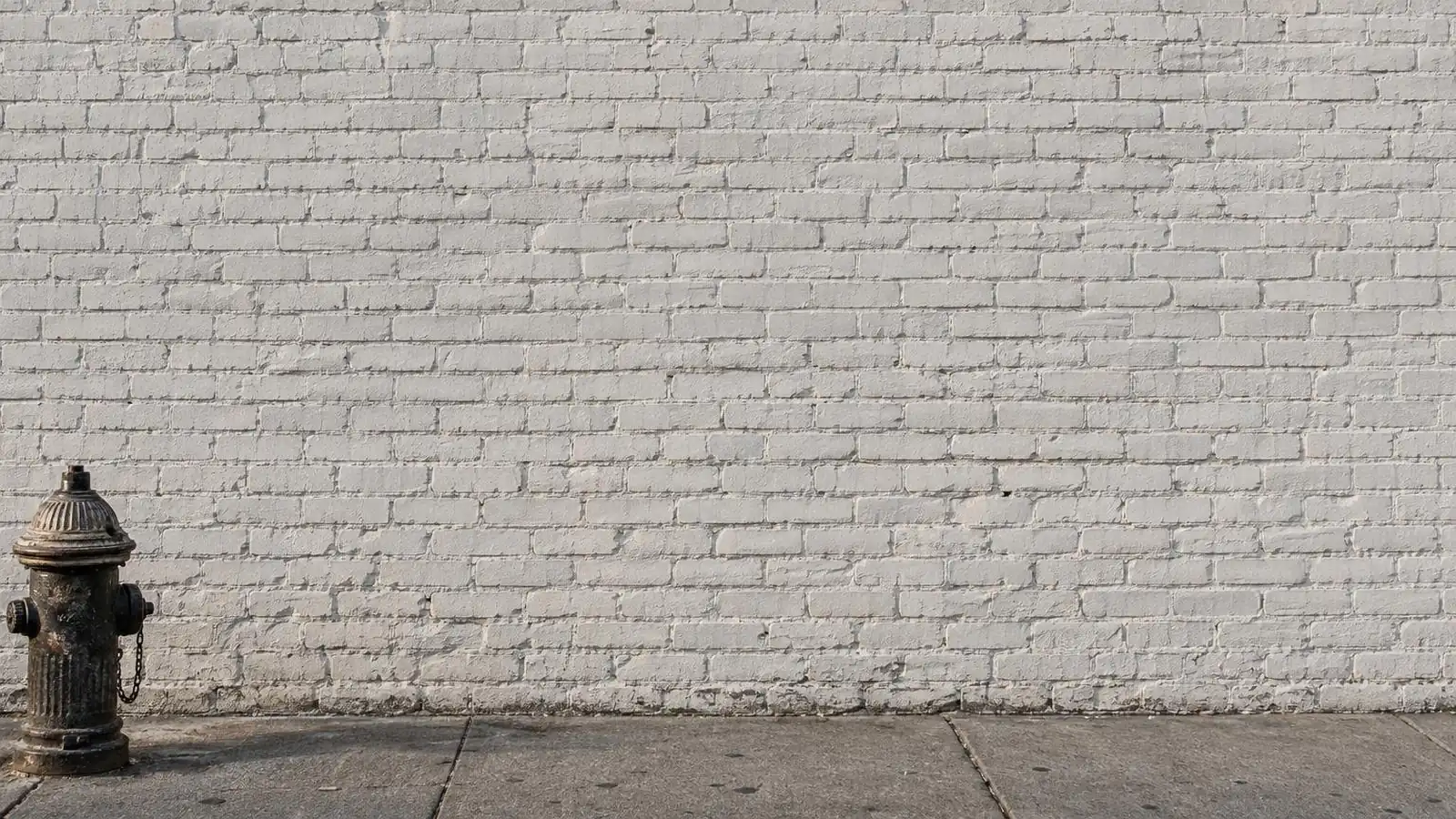
A white brick wall in upper Manhattan. Shake the can and write your own name and the number of your street, the way they did.
In late-1960s Philadelphia a teenager called Cornbread wrote his name all over the city. In New York, Julio 204 wrote his around Inwood, and then came TAKI 183: Demetrios, a Greek-American boy from 183rd Street in Washington Heights who worked as a messenger and left his name wherever the job took him.
On 21 July 1971 The New York Times ran a story about him, “'Taki 183' Spawns Pen Pals”. Within months hundreds of kids were writing a name and a street number, and competing over who had the most.
1972–1989 · New York subway
Whole cars
A tag on a wall stays put. A tag on a train rides through the whole city.
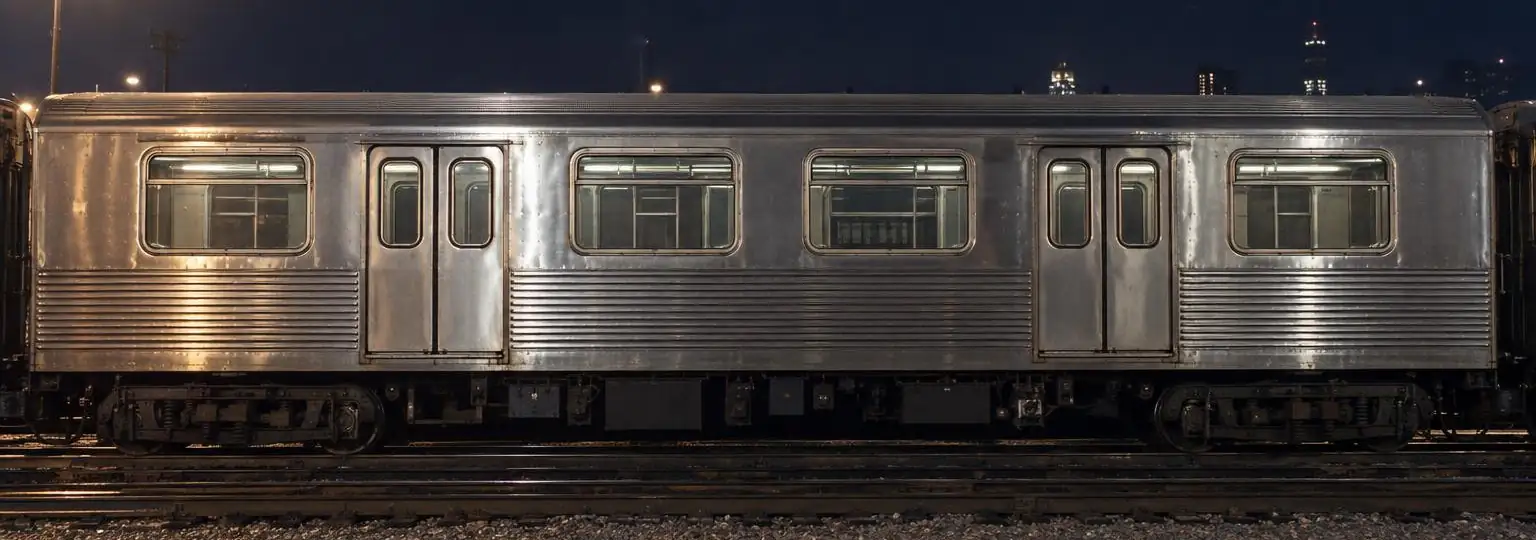

A 1970s car in the yard. The piece is ours, painted in the style of the time; the buff button does what the transit authority did.
Writers moved from walls to trains and from tags to pieces, short for masterpieces. In late 1972 Phase 2 painted the first bubble letters, and soon pieces ran top to bottom and end to end. Dondi of the CIA crew painted his whole cars “Children of the Grave” between 1978 and 1980, and the train yards became open-air studios.
The city answered with fences, dogs and the buff, the chemical wash. From 1984 any painted car was pulled out of service and cleaned, and on 12 May 1989 the last graffiti-covered train left the tracks. By then the book Subway Art by Martha Cooper and Henry Chalfant (1984) and the films Wild Style and Style Wars (both 1983) had carried the style around the world.
1980–1983 · New York
From the subway to the gallery
The same artists and the same hands, on a different wall.
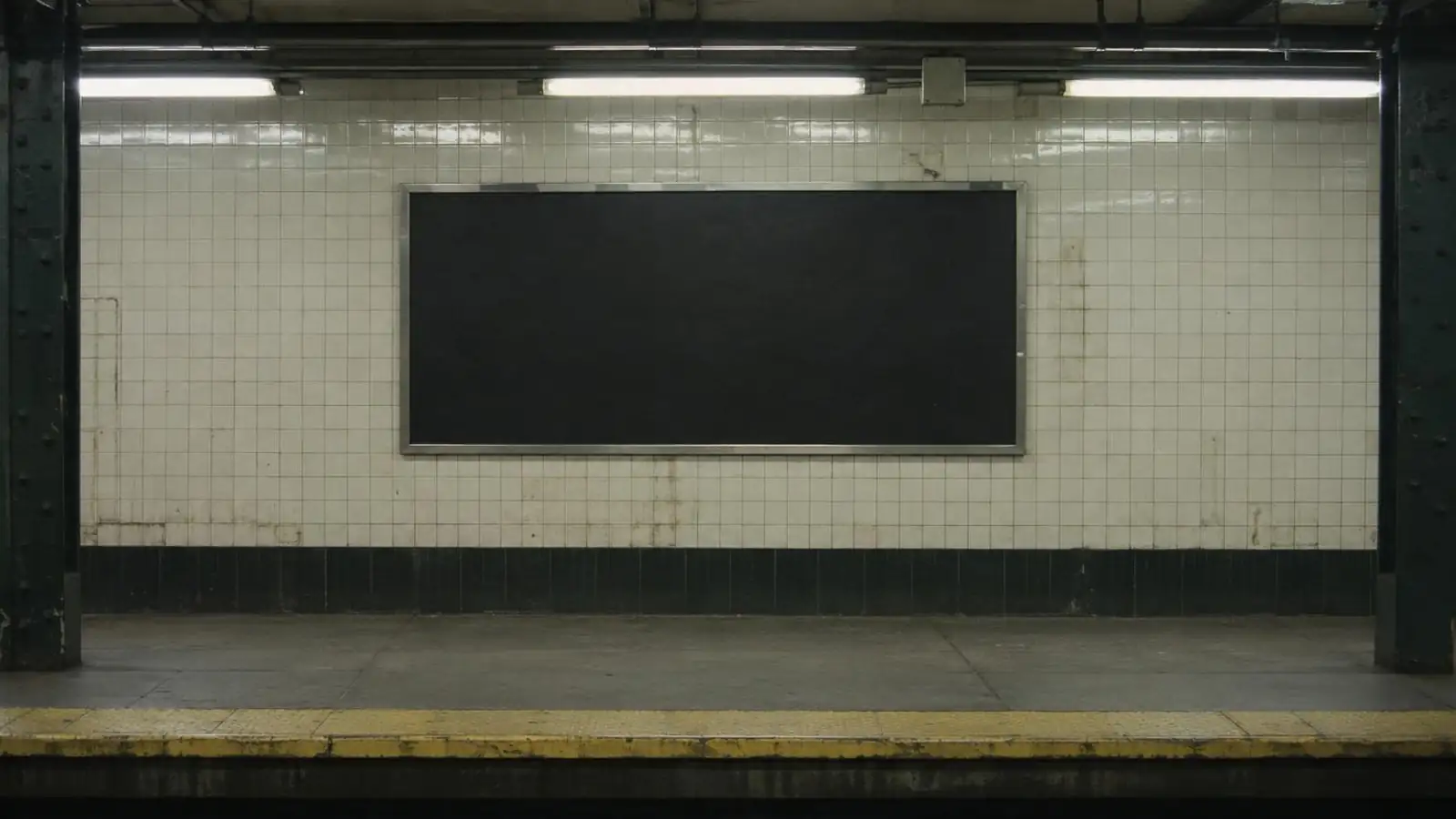
A subway station, then a gallery wall. Draw on the black panel, then move your drawing indoors.
In June 1980 the Times Square Show filled an empty building near 42nd Street with art, Jean-Michel Basquiat and Keith Haring among the artists. Haring drew in white chalk on the black paper pasted over empty advertising panels in subway stations: hundreds of drawings between 1980 and 1985. Basquiat had written cryptic lines on downtown walls as SAMO© with Al Diaz; by 1981 he had his first solo show.
Futura 2000 painted live on stage with The Clash in 1981 and took graffiti into abstraction. In December 1983 the Sidney Janis Gallery opened a show called “Post-Graffiti”. In 2017 a 1982 painting by Basquiat sold at Sotheby's for $110.5 million.
1981 · Paris, then Bristol
Cut once, spray anywhere
A stencil turns a picture into a few seconds of work, which is all a street gives you.
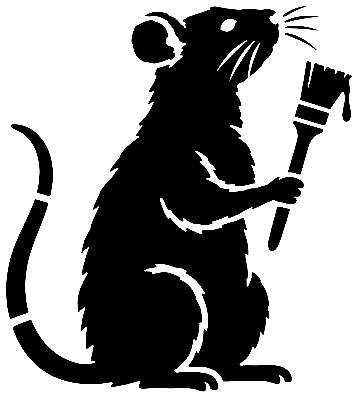
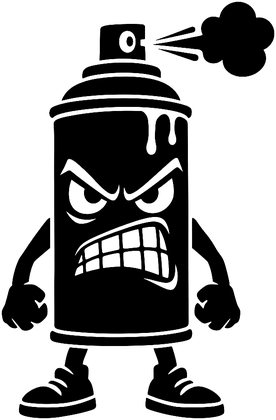

Our own stencils on a Paris wall. Each tap lays the card, sprays and lifts it.
In 1981 Blek le Rat, Xavier Prou, began spraying stencilled rats on the walls of Paris (“rat” is an anagram of “art”), and later life-size people. Two decades on, a Bristol writer who had started freehand switched to stencils and became Banksy, who admitted that whenever he thought he had painted something slightly original, he found Blek le Rat had done it as well.
On 5 October 2018 Banksy's Girl with Balloon shredded itself at Sotheby's seconds after it sold for £1,042,000. Renamed Love is in the Bin, it sold again in 2021 for £18,582,000.
1989 · Providence, then everywhere
Slap it on
A sticker is a tag made at home and put up in a second.
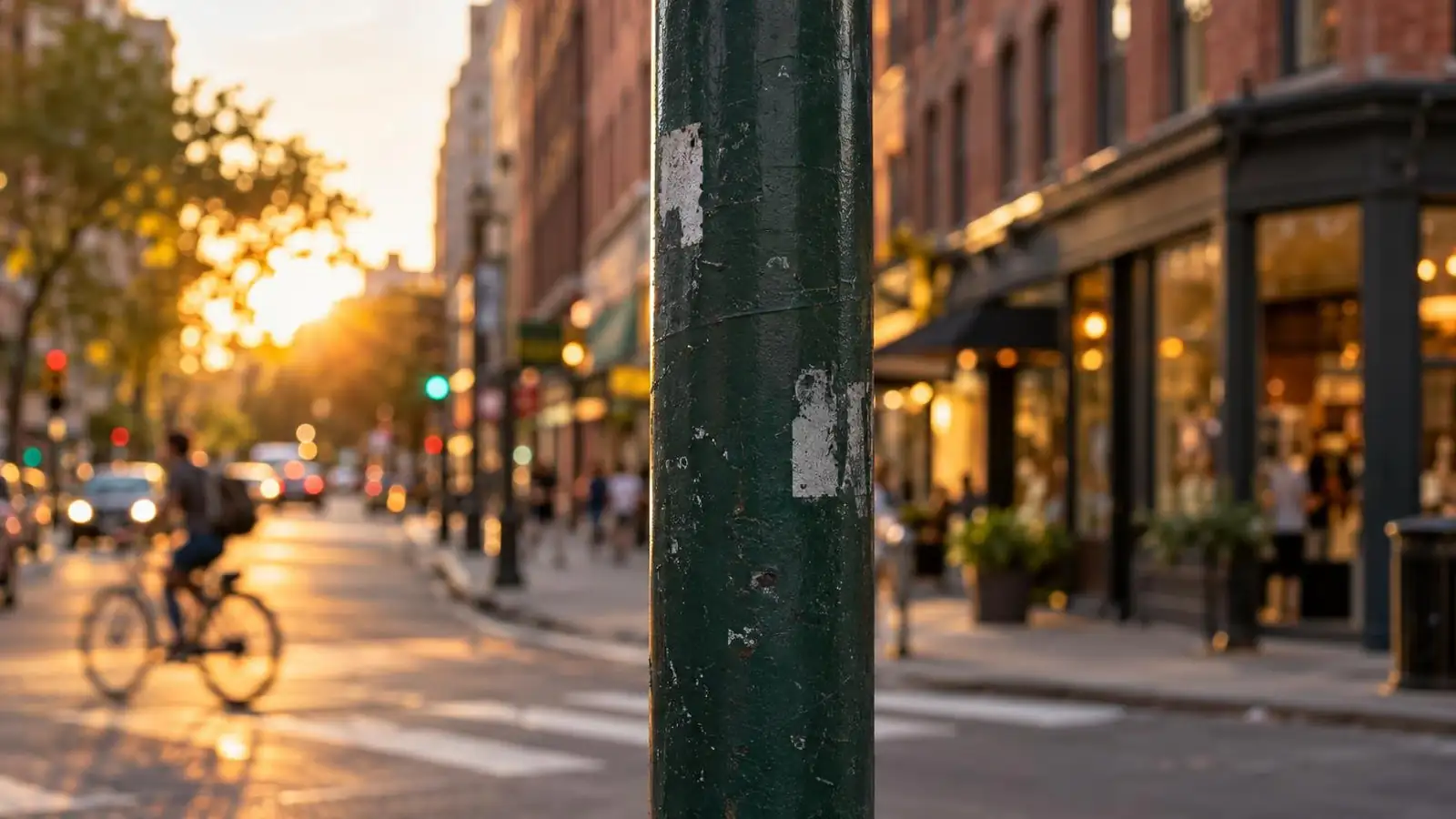
A street pole on a city corner. The stickers are our own designs; where they go is up to you.
Writers used free postal labels and “Hello, my name is” name tags as slaps. In 1989 Shepard Fairey, a student at the Rhode Island School of Design, made a sticker of the wrestler André the Giant; it grew into OBEY and, in 2008, into the Hope portrait that now belongs to the National Portrait Gallery.
Paste-ups and mosaics follow the same logic: make it in the studio, put it up fast. Since the late 1990s Invader has fixed tiled space invaders to walls in dozens of cities.
2008 → today
Murals take the city
Street art went from the wanted list to the museum façade, and then to the commission.
In 2008 Tate Modern hung giant works by Blu, JR, Os Gêmeos and others on its river façade; in 2011 MOCA's Art in the Streets in Los Angeles drew a record 201,352 visitors. Districts like Wynwood Walls in Miami (2009) and festivals around the world now invite artists to paint whole buildings, legally and in daylight.
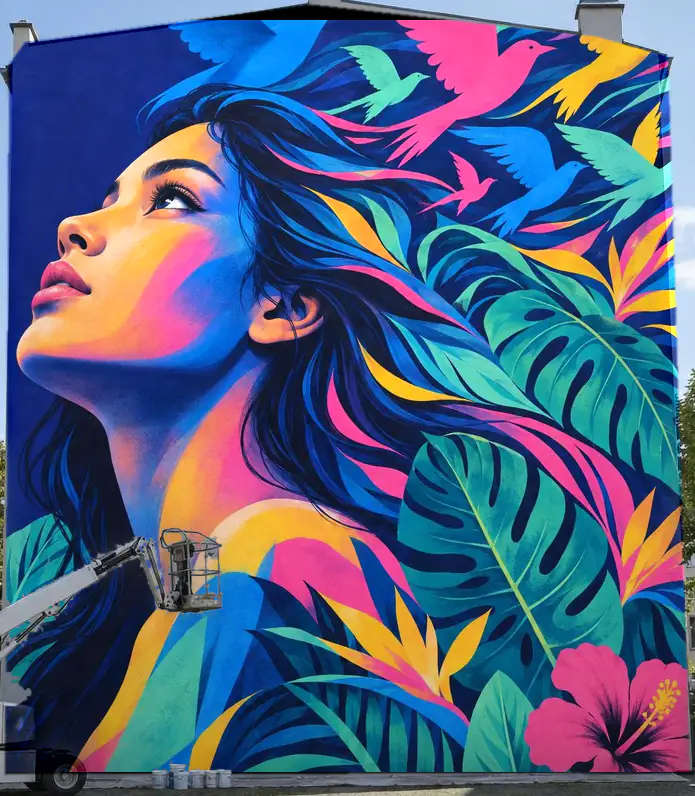
The hard part is the same as in Rivera's day: getting a sketch the size of a page onto a wall the size of a house without losing the proportions. Muralists do it in four ways; switch between them on the wall.
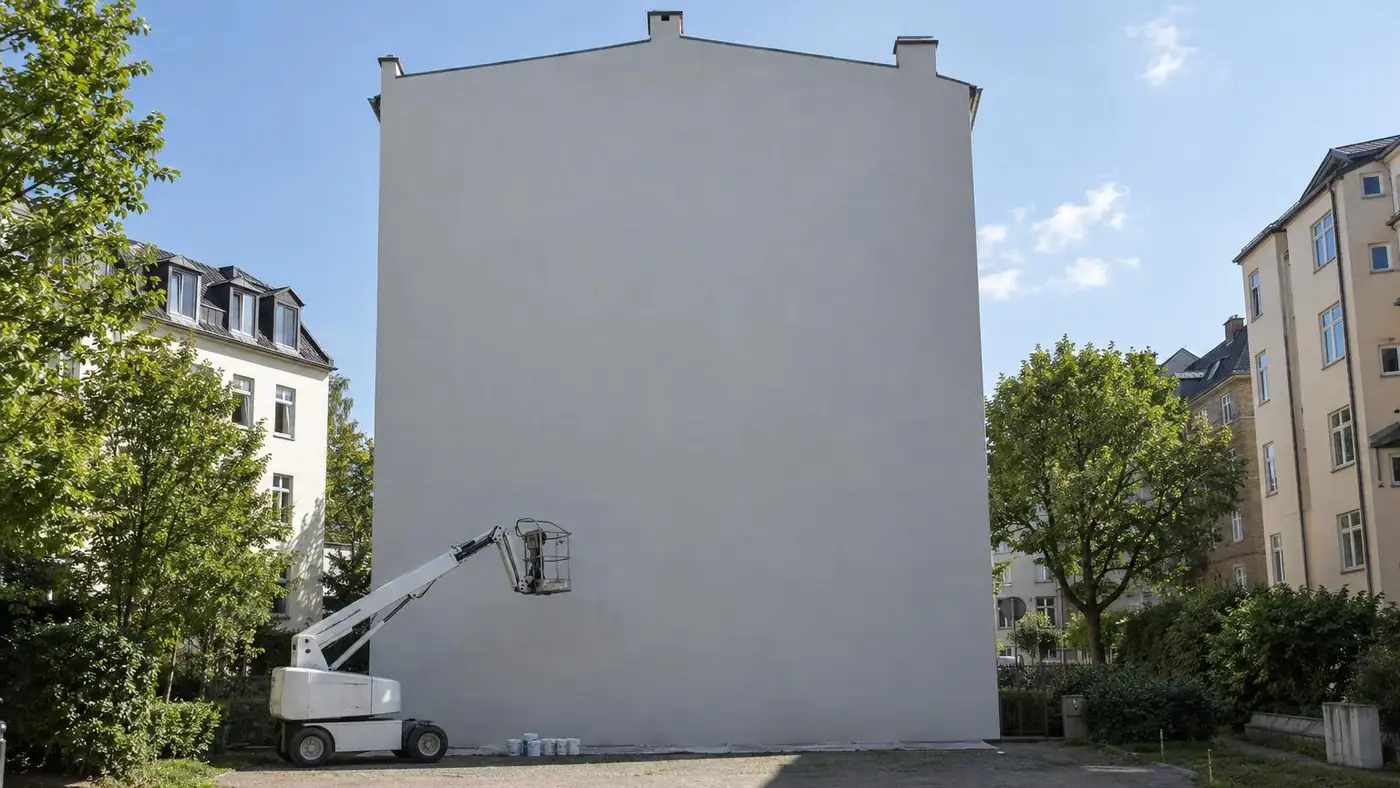
- GridSquares on the sketch, the same squares on the wall, copied one by one. 3–6 hours of measuring.
- ProjectorThe sketch is thrown onto the wall and traced. 1–2 hours of setup, and only after dark.
- Doodle gridRandom squiggles on the wall, photographed and used as landmarks. 2–4 hours.
- HeadsetThe sketch is placed on the wall in mixed reality and traced in daylight. 10–20 minutes.
- FinishedThe same wall, painted. The method decides how long the start takes, not how good the wall is.
Setup times for a 5 × 10 m wall, from Sketchar's comparison of mural methods. The mural is an illustration.
2017 · Sketchar on HoloLens
A projector that works in daylight
The sketch moved from paper into the glasses, and the wall became the canvas.
The view through the glasses: the sketch appears in the lens, the paint goes on the real wall.
In July 2017 Sketchar launched on Microsoft HoloLens, the first fully untethered holographic headset. The artist sees the sketch pinned to the real wall through the glasses and traces it with a spray can: no projector, no grid, no waiting for dark. Sketchar's founder, the artist Andrey (Adno) Drobitko, had come up with AR drawing back in 2012, after too many nights tracing walls with a projector.
That was the start of the mural assistant that now runs on Meta Quest and Pico. The story of the HoloLens years is on our blog, and the whole road from the camera lucida to AR glasses is in our long read on the history of augmented reality.
Today · Your wall
Your sketch, on a real wall
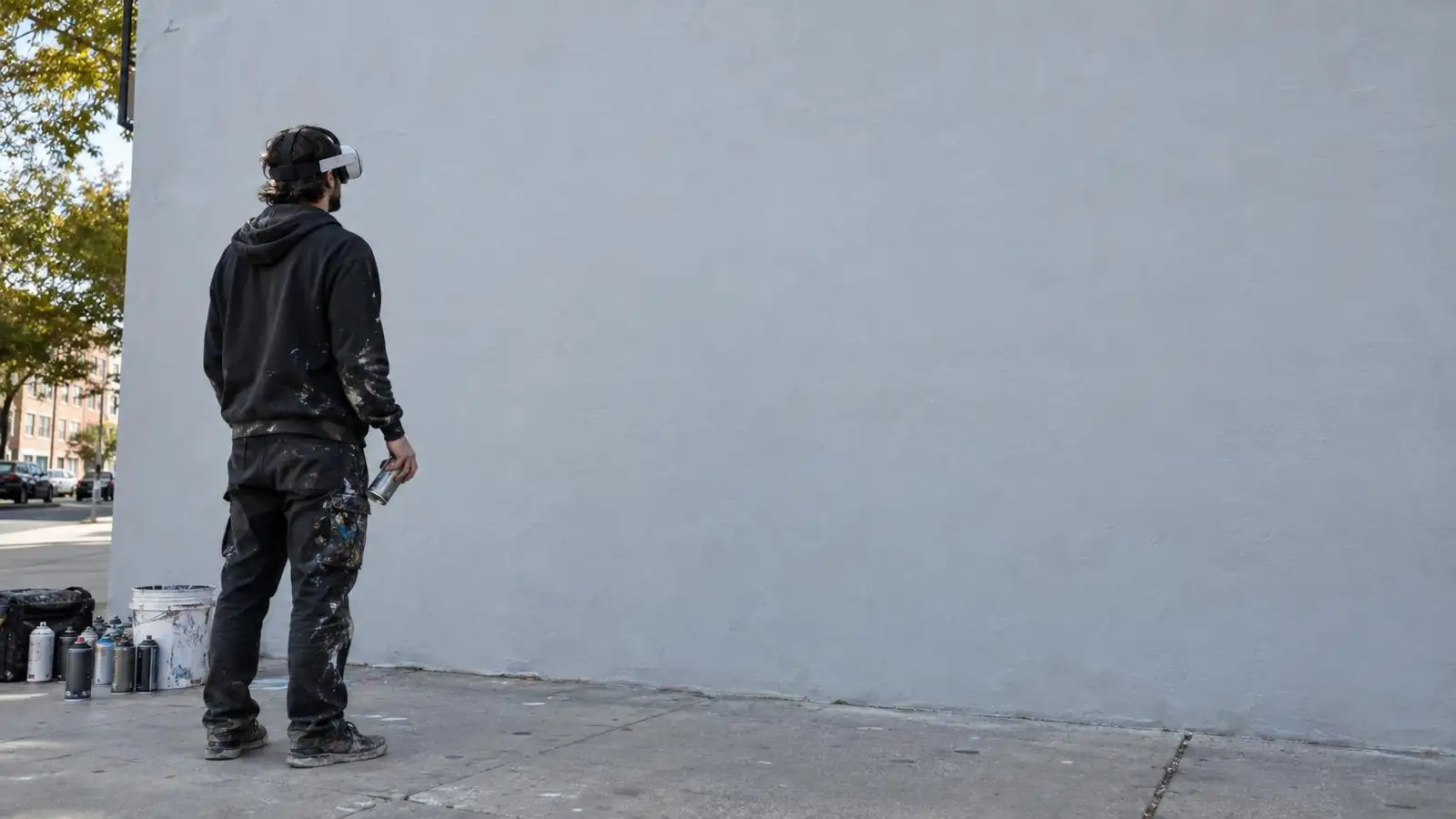
Sketchar on Meta Quest puts your sketch on the wall in front of you, life-size and in daylight: no projector, no grid, no waiting for dark.
 Sketchar
Today muralists use Sketchar on Meta Quest and Pico to paint basketball courts, apartment blocks and festival walls: send a sketch from your phone, place it on the wall, trace. Move the headset view across the wall to see what they see.


 Mural App · Guide
A beginner's guide to mural art with Sketchar
Install the app, sync your images, place a sketch on a real wall and paint corners and collages in VR.
Read the guide →
Keep reading
- Street art vs graffitiThe difference, from someone who has painted both→
- How to paint a mural on a wallPlan, prime, transfer and paint, step by step→
- Projector vs grid vs doodle grid vs VRHow to scale a mural, compared→
- 25 years of graffiti meets AR/VRFive questions for the muralist Konstantin Zmogk→
- Mural festivalsHow to get selected→
- 40,000 years of art, in one scrollAnother Sketchar Editorial long read→
Questions people ask
People have written on walls since antiquity: Pompeii, buried in 79 AD, kept thousands of scratched inscriptions. In the 1820s the Viennese clerk Joseph Kyselak painted his name on rocks and walls across the Alps. Graffiti as we know it today, names written in marker and spray paint, began in Philadelphia and New York in the late 1960s and spread through the New York subway in the 1970s.
There is no single first. Cornbread (Darryl McCray) is often called the first modern writer for tagging Philadelphia in the late 1960s. In New York, Julio 204 and TAKI 183 came next, and a New York Times article about TAKI 183 in July 1971 made the practice famous.
A Greek-American teenager named Demetrios from 183rd Street in Washington Heights, Manhattan. He worked as a messenger and wrote “TAKI 183” wherever he went. On 21 July 1971 The New York Times wrote about him, and hundreds of kids copied the name-and-street formula.
Graffiti is rooted in letters: tags and pieces, written mostly for other writers and usually without permission. Street art is the wider family of stencils, stickers, posters, mosaics and murals, usually built around images, made for passers-by and today often commissioned.
A train carried a name through the whole city every day, so one painted car reached more people than any wall. From 1984 the transit authority pulled painted cars out of service at once, and on 12 May 1989 the last graffiti-covered car left service.
With a grid, a projector, a doodle grid or an AR/VR app. For a 5 × 10 m wall a grid takes 3–6 hours of measuring, a projector 1–2 hours and works only after dark, a doodle grid 2–4 hours, and a mixed-reality headset such as Meta Quest with Sketchar 10–20 minutes, in daylight.